
From Stephens Fry's Podgramme 'Episode 3: Wallpaper' dated 9th April 2008 (wherein which Stephen Fry is talking about an answer Oscar Wilde gave to a question whilst touring America:
'“Why, Mr. Wilde, do you think America is such a violent country?”
“I can tell you why,” he said. “It’s susceptible readily of an explanation. America is such a violent country because your wallpaper is so ugly.”
Now that seems, you might snort with laughter at first and say, “Well, how amusing.” Part you you may say, “Well this is just a typical peacocking primped camp remark from a shallow and trivial man who thinks it’s amusing to say things like that.”
But actually, to understand what the Aesthetic Movement is all about, one has to take that quite seriously. Instead of judging things as being good or bad, things are judged by whether they are beautiful or ugly. And we may say beauty is in the eye of the beholder, but actually it’s a lot easier to judge when things are beautiful than it is when things are bad or good. We spend our time puzzling dreadfully over whether we can interpret something as being wicked or whether it’s virtuous. However, beauty, beauty, beauty acts on us in a very real way, and what Wilde was partly saying was, if we look out of the window into our world, we see things that are universally and entirely beautiful from nature. Whether they be palm trees swaying in an island, whether they be the arctic wastes, whether they be deserts, tundra steps. It doesn’t matter where you look in the world, we see nothing but beauty. Unconditional, remarkable beauty.
Except where man has intervened.
And what Wilde is saying is, imagine belonging to a species where all you believe that all you can do to the world is to uglify it. To make it worse. To despoil it. Which is what we do. We know that now in real and profound and terrible ways that Wilde couldn’t have known about because the science hadn’t yet discovered quite how harmful we are as a species to our planet. But he could see that we were harmful to our planet in terms of its aesthetics. That we were making the earth uglier. Uglier with bad architecture, uglier with badly designed factories, uglier with badly stamped out tin trays and cheap ornaments, ugly with appalling wallpaper. And if you’re someone who grows up in such an environment, who is surrounded by badly made ugly things, then you think ugly thoughts of yourself and world. You think ugly thoughts of your whole species. There is nothing for you to do but to, to, to crap in your own nest. It’s what we do when we don’t believe in ourselves. And so although it seems a cheap response to a question about violence, the aesthetic point if view is actually I think a very valuable one, a very profound one, a very extraordinary one. And it makes people think beyond the knee-jerk reflexes of conventional morality, of revealed texts, whether they be the Bible, the Koran or the Communist Manifesto. It doesn’t matter. You’ve got to think harder than that, Wilde was arguing'.
27.1.09
The weather outside is frightful...
…but the streets are so delightful. A little late, perhaps, to be using puns based on Christmas themed songs but, in London at least, it is still winter.
January, a month people tend to loathe… why? Well here in the UK, people tend to have less money just after the expense of the Christmas and New Years holidays, there is no public holidays until Easter and in January you are only half-way through winter with short days (although lengthening) and miserable weather still plentiful. A lot of time and money is spent on Christmas markets, street-lights, festive entertainment and public space decoration in the build up to December 25th and January 1st… but shortly after, it all disappears to leave a cityscape that feels bland, boring and, well, harsh in comparison.
A bulletin by the US based ‘Projects for Public Spaces’ examines the animation of cities in the build up to traditional European winter holidays and then follows these lessons in looking at how certain conurbations apply these creative placemaking techniques to form winter-long programmes. Alarmingly notes Walljasper, author of the piece:

‘A common and tragic mistake that many North American winter cities have made in recent decades is to try and engineer winter out of existence. This is seen most prominently in second-story walkways (called "plus fifteens" in Calgary, "skywalks" in Winnipeg, "skyways" in Minneapolis and Des Moines, "pedways" in Chicago and Edmonton) that allow people to circulate around downtown areas without stepping outside. A good idea on paper, perhaps, but in practice, the life of the city is removed from the streets and eventually disappears’.
With examples of ice-skating in Paris, seasonal lighting in Salzburg and sculpture exhibits in New York - it is clearly important to remember that cities need attractive and varied cultural programming to create welcoming, interesting, curious, comfortable, accessible and innovative spaces. The weather or climate shouldn’t be seen as an obstacle to this, and with the correct thinking behind any socially convivial planning, should be an active, positive central element in any outcome. Lessons to be learnt for all manner of built environments facing a less temperate climate at some point throughout the year:
‘A frequent mistake made in winter cities is to overemphasize the impact of the weather, using it as a rationale for why they don't have great public spaces. "When people in a city use the climate as an excuse for mediocrity--and that happens in hot places where we work, too, like Dubai and Tempe, Arizona--" says Nikitin, "then I know the problem is not weather but the need for a bigger vision in that place’’.’
A call-to-arms for urban designers, planners, landscape architects, architects, councils and so on to enage with and/or consider the likes of artists, theatre companies and local business in responding to inclement weather with imagination and ingenuity... Lets just remind ourselves that we are thinking about climate's link with daily weather, and unlike weather alone it is longer lasting and paints more the annual picture and patterns of weather over many years.
Any investment in evolving public space to be just as useable during more adverse conditions, or in using public space full stop, to be fully successful, should be met with a long-term, broad vision – rather than just with advent in mind.
January, a month people tend to loathe… why? Well here in the UK, people tend to have less money just after the expense of the Christmas and New Years holidays, there is no public holidays until Easter and in January you are only half-way through winter with short days (although lengthening) and miserable weather still plentiful. A lot of time and money is spent on Christmas markets, street-lights, festive entertainment and public space decoration in the build up to December 25th and January 1st… but shortly after, it all disappears to leave a cityscape that feels bland, boring and, well, harsh in comparison.
A bulletin by the US based ‘Projects for Public Spaces’ examines the animation of cities in the build up to traditional European winter holidays and then follows these lessons in looking at how certain conurbations apply these creative placemaking techniques to form winter-long programmes. Alarmingly notes Walljasper, author of the piece:
‘A common and tragic mistake that many North American winter cities have made in recent decades is to try and engineer winter out of existence. This is seen most prominently in second-story walkways (called "plus fifteens" in Calgary, "skywalks" in Winnipeg, "skyways" in Minneapolis and Des Moines, "pedways" in Chicago and Edmonton) that allow people to circulate around downtown areas without stepping outside. A good idea on paper, perhaps, but in practice, the life of the city is removed from the streets and eventually disappears’.
With examples of ice-skating in Paris, seasonal lighting in Salzburg and sculpture exhibits in New York - it is clearly important to remember that cities need attractive and varied cultural programming to create welcoming, interesting, curious, comfortable, accessible and innovative spaces. The weather or climate shouldn’t be seen as an obstacle to this, and with the correct thinking behind any socially convivial planning, should be an active, positive central element in any outcome. Lessons to be learnt for all manner of built environments facing a less temperate climate at some point throughout the year:
‘A frequent mistake made in winter cities is to overemphasize the impact of the weather, using it as a rationale for why they don't have great public spaces. "When people in a city use the climate as an excuse for mediocrity--and that happens in hot places where we work, too, like Dubai and Tempe, Arizona--" says Nikitin, "then I know the problem is not weather but the need for a bigger vision in that place’’.’
A call-to-arms for urban designers, planners, landscape architects, architects, councils and so on to enage with and/or consider the likes of artists, theatre companies and local business in responding to inclement weather with imagination and ingenuity... Lets just remind ourselves that we are thinking about climate's link with daily weather, and unlike weather alone it is longer lasting and paints more the annual picture and patterns of weather over many years.
Any investment in evolving public space to be just as useable during more adverse conditions, or in using public space full stop, to be fully successful, should be met with a long-term, broad vision – rather than just with advent in mind.


25.1.09
Los Angeles Plays Itself
Wednesday saw the latest screening in the Architecture Foundation's ‘Architecture on Film’ season at the Barbican in London. Thom Anderson’s ‘Los Angeles Plays Itself’ (2003, US), an essay inviting the audience to think about what has been referred to as Hollywood’s ‘war against modern architecture', reversed the audiences perception of how they have been directed to view film. Bringing out the architectural background of over 200 films featuring the city’s buildings, Anderson let these structures become the subject of the films he cites and instead of alienating them from the cinematic context they were in, analysed their positioning to begin discussion on how they have been manipulated by filmmakers to create all manner of cinematic places.
Further, in commenting on the frequent use of geographical licence in Hollywood cinema (something that is symptomatic of all cinemas), Anderson’s empirical observations of the both generalised and specified L.A. cityscape highlighted how urban spaces are ubiquitous to film. ‘Los Angeles Plays Itself’ lacked conclusion but was after all a call to thought more than a thesis leading to concrete closure. Anderson succeeded in drawing attention to elements of cinematic space that are often over-looked in comparison to plot, editing and other cinematic techniques. An audience consisting of both film-savvy individuals and built environment professionals responded to the film, as the director clearly would have hoped for, with thought and laughter.
The screening was followed by a short presentation by Kodwo Eshun, writer, theorist and founder of the artists collective Otolith Group – whom further highlighted Anderson’s key observations and examples and acted to facilitate the idea that the film was an exercise in opening up a wider reading of space and place on screen.
22.1.09
The sign-less city
I’ve stumbled across a blog post by Willie Miller Urban Design (WMUD), a Glasgow based ‘creative interdisciplinary consultancy’, which highlights the ‘Hidden Town’ work of Gregor Graf and it’s relationship to the question ‘How do we read a city without signs?’:
‘With a mixture of purist medium format photography and Photoshop, Graf has painstakingly deleted all traces of language and signage from view - as well as people and cars’.
The post is very interesting and I would just go onto repeat all of what they have said, word for word, so I won’t – but below are some eerie images of London from Graf’s work:
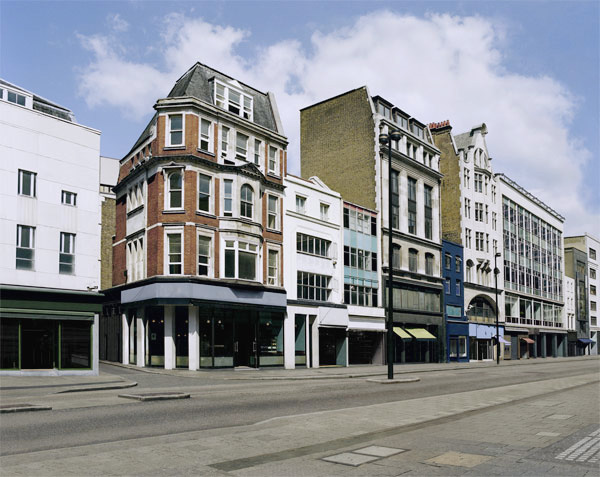
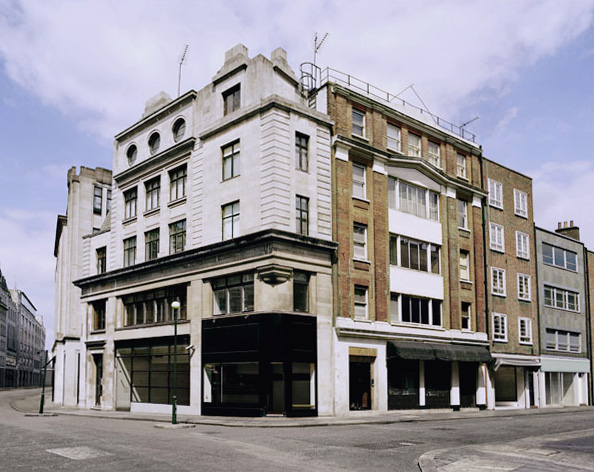
As WMUD highlight the ‘Hidden Towns’ images are a step-on from a radical ban on advertising implemented in São Paulo in 2007, leaving a cityscape vacant of, perhaps surprisingly, not just advertising but regularly used ‘mental nodes’ of navigation:
 This links in quite well with the work of Legible London whom have not only identified the value of mental nodes in navigating around a city but also the confusion and clutter caused by excessive signage (to which advertising arguably adds). Graf's work strips away the deeply coded iconography of the urban domain and creates a blank canvas which is both disorientating but also revealing of the very essence of the shape, fluidity, depth and breath of part of a city. Of ‘Hidden Towns’ and the São Paulo ban, WMUD note:
‘The implication of these unreal and real examples is that in the absence of signs, people need to re-learn what was once recognisable city terrain, marked out urban space, defined focal points and obvious boundaries. One of the São Paulo experiences was that it was initially easy for people to get lost when well known reference points - such as 48-sheet hoardings - were removed. Of course, residents were quick to re-orientate themselves around landmarks, buildings and urban form very much in the way that architects, urbanists and writers on the city would like them to behave’.
Proof, therein, that urban realms are successfully navigated sans signage - but also, reminder of the potential for the unison of effective sign-posting which relates more directly to a conscious urban topography, that can produce places that are identifiable, welcoming and that work. Reason, to encourage not only good signage of the built-environment, but also of the need for ever-more effective and thoughtful urban design.
13.1.09
2009: An Under-the-Thames Odyssey of everday objects

Last weekend the newest station on the DLR opened with an all-new under-Thames tunnel. Most notably the opening of Woolwich Arsenal DLR station also saw the unveiling of a new piece of public art.
Michael Craig-Martin was comissioned to produce a major work for the new station, to be integrated with the fabric of the building, and needless to say I happened to go and have a look.
The BBC have video on the artist and the new station here, whilst Artdaily.org have posted a short insightful article.
'Craig-Martin explores the dialogue art opens between representation and reality and between artist and viewer. The set of everyday objects appearing regularly in his works are flattened and simplified, functioning as words do in language. The selection of these objects, their color, spatial relationships and juxtaposition provide the work's tension and narrative. Giving us his set of everyday objects as pictograms Craig-Martin describes the modern world we share'. - DLR art
Subscribe to:
Posts (Atom)


 Posts
Posts

