30.10.08

Is this your airport or mine?


Another 'lunch ‘n‘ learn' today at CABE and this time Maurits Schaafsma was talking about the spatio-economic vision for the Schiphol region of Holland… Maurits is a Strategic Urban Planner at Schiphol Group, responsible for spatial planning, urban design, architecture and concept development… so not so surprisingly his talk was mainly based around the growth of Schipol airport from its birth just before the 1920’s to the present day.

Truth be known the presentation itself was a little ‘flat'… and having eaten a number of sandwiches the post-lunch slump started to kick in. I was hoping for some insights into cutting edge airport urban design and management – and whilst I got wind of ‘tangential runway systems’ and the spatial aspects of an ‘airport city’ it was the Q&A afterwards that proved to be most thoughtful.

Someone raised the matter of the neutral images of airports… how essentially each one looks like any other no-matter where in the world you are… and that perhaps there is a way to move forward in the development of these very busy public spaces in reflecting the locality or nationality of where they are. Which is a good point.

So there I was thinking: ‘what does make a good airport’? Well essentially, if a BBC article on Heathrow Terminal 5 is any guide, there are 5 key things:

- design
- signage
- retail
- transport
- no queues

Ok, it was quite a crude article but some starting points none-the-less. Conversely a blogger of sorts also on the BBC posted a rather funny guide to what doesn’t make for good airports. Obviously a grumpy traveller.

A little more googling and it turns out there is some impressive and exciting stuff on the horizon… in particular designboom.com offer these fine examples:


Incheon international airport, transportation centre, South Korea:


Carrasco international airport expansion, Uruguay:


Bangkok international airport, Thailand


Beijing international airport, China


Impressive and iconic stuff (interesting that 3 of them are in the far-east) - but I wonder how effective they will be in promoting a sense of 'national identity' in welcoming visitors... and how they will work as successful international transport hubs... time will tell...

At least they certainly beat more ‘quaint’ examples:

28.10.08

This Is Not A Gateway


This weekend just gone saw east London host the ‘This Is Not A Gateway’ festival. I’m going to put it in their own words:

This Is Not A Gateway {TINAG} is a voluntary organisation that creates arenas/platforms for those whose point of reference is the city. Working across disciplines, TINAG encourages inter-cultural dialogue and rigorous production…’ – so there we go.

The festival was made up of a mix of exhibitions, films, workshops, discussions groups and seemed very interesting – but unfortunately I wasn’t able to attend… however if I could have I would have personally been really interested in the following:

Exhibitions:
4 in particular, all at café Otto in Dalston… one was a series of drawings exploring the ‘strangeness of people living in cities’ by Karolin Schnoor... the others showed various photographic work from Laura Braun (Dalston Postcards), David San Millian Del Rio (Passerby) and Gesche Wuerfel, Tristan Fennel and David Kendall (A Line Is There To Be Broken) – which was a collection of ‘photographs that scrutinise struggles between transformations of ‘place and ‘space’... studies of disruptions in ‘everyday life’ and the landscape’.

Film:
A selection of screenings called ‘Ways of Living: A film screening in epic chapters’ which was related to travel, migration, tourism, location and the wider concept of the journey. I really have a habit for enjoying, appreciating and wanting to pull apart depictions of travel in film – how it’s presented, what it comes to symbolise… the nature of changing ‘places’ on screen… and also, conversely, the way in which locations and travel impact upon the production and dissemination of film. So this would have been a treat.

Discussion:
Specifically ‘Writing the City: Regeneration and Literature’ which had the aim of considering ‘how might literature and community arts intersect with architecture urban design, planning and development’… which was chaired by Sarah Butler of Urban Words.

Workshop:
‘Influencing the City: The art of making space’ which saw ‘young urbanists present their different experiences and new models for creating and running independent urban cultural [workspaces]’. Essentially it seems this was mainly about considering how creative ‘hubs’ all over Europe have appeared in urban areas and were initially provided by governments or authoritative bodies but are now appearing through different frameworks. Quite interesting in considering the likes of official exhibitions spaces such as galleries and bars in areas of London like Shoreditch that also inter-mix with unofficial exhibition spaces like walls/alleys/coves – mainly out on the street.

Thanks to the inter-web I can take a look at some of the stuff online but obviously it’s not as good as if I had been able to go! Still… names to remember for the future and some food for thought from just hearing about what some of the festival was about… Also, there are plans to publish a Festival Anthology – so hopefully there’ll be some interesting bits in there when it comes along!

23.10.08

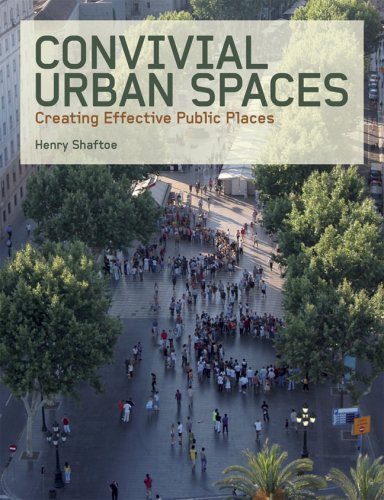
Convivial Urban Spaces...

Henry Shaftoe from the University of West England gave a presentation at CABE on Tuesday... mainly focusing on his new book the theme was, you've guessed it, convivial urban spaces. For the more experienced 'urbanists' present he didn't seem to offer anything particularly new - but for myself it was nice to get a break-down of what research had shown made for sociable, lively and pleasant places... namely spaces that:
  • are inclusive & democratic
  • contain sitting places (!)
  • are well maintained and clean
  • feel safe and nonthreatening
  • have a distinctive character and identity
  • incorporate natural features
  • contains comfortable micro-climates
  • ban or tightly control vehicular circulation

Henry went on to break these down into 4 key elements 'urbanists' should consider when developing urban spaces:

  1. It's physical design
  2. The geographical location
  3. Management (including fixed and temporal animation of space)
  4. The Psychology of a space

The mention of the animation of public space got me down a path of thought that had me doodling away on my note-pad... particularly in thinking about temporal art. It's something I've been pondering for a while - but it was nice to have it 'boxed' as an aspect of public space that interests me and that has interconnections with notions of place as a whole.

Henry also went on to talk briefly about the idea of 'provisional spaces'... which wasn't something I'd thought about before - but the idea struck me. He was thinking about a method for creating places that was based upon developing an initial spatial plan, implementing it, testing it, evaluating feedback on how it does/doesn't work, amending it... and then eventually finishing with a final version of the space...


20.10.08

Rome wasn't built in a day...

Well, there's no time like the present!

Welcome to my blog! This is my first post, and the first thing I would like to do is apologise for any spelling and/or grammatical errors that are certain to appear at some point or another!

This is my blog... and I'm not quite sure what I want to do with it yet, other than use it to write about all the random things I come across that interest me in terms of the urban world...

I suppose I'm really interested in anything that makes up the 'urban composition'... thus the title of this blog...: the urban composition.

For me, I can break down what I really want to blog about into 4 categories... my 4 main urban interests:

1. geographically-spatial stuff
so mainly anything to do with architecture, planning, urban design etc...

2. iconographically-visual stuff
here I'm thinking about the urban world on screen, in films, in photos as well as urban iconography... signs, posters and things like that...

3. dramatically-kinetic stuff
this is mainly all about performance art - especially site specific theatre... but also the urban world in written literature and song...

and

4. artistically-tangible stuff
which is the sort of art that involves sculpture, light and texture... to a degree urban sound-scapes and slightly more 'off-beat' stuff like that...

So... there we go! I've (sort-of) set my agenda... I'll be testing out the blog over the next few months and working out how best to use it as an opportunity to leak my thoughts into the world and communicate ideas with others... this is a subjective blog, but it's not personal... my aim is to jot down my ideas and reflect my journey of discovering and thinking about the urban world... as well as a focus on stuff that might provoke the curiosity of other 'urbanists', urban designers, planners, architects, artists, performers, writers, designers... even policy makers and the like!

I expect I'll write quite ad-hoc... whilst I test the blog out - anything from several times a day to once or twice a month... and if anything catches your eye... feel free to contact me...

:-)