16.12.08

Let there be light!

'Sensationalist, biased articles in national newspapers, token switch-off ceremonies and misguided legislation have made it even more important that sustainable lighting design is promoted positively to the public… The fact remains that, despite what some hysterical reports say, we need light in our night-time urban environment. Accident prevention, reduced crime and a reduction in the fear of crime and promoting the use of streets after dark thus enhancing peoples' freedom to interact and be mobile after dark are all extremely important factors… Although we understand that energy use is a 'burning issue', we need light to live and as our lifestyles evolve, the benefits of good urban lighting are undeniable. The perception is that architectural lighting leads to wasted energy and light pollution. However, the majority of the lighting industry continually strives to tackle the issue of energy. From luminaire design that avoids light pollution to the promotion of lower energy and more efficient sources, the lighting industry is well educated in recycling, waste issues and the misuse of our natural resources… an opportunity to use light to educate the public and newspaper journalists alike[, i]t is essential to illuminate better, not less’.

Paul James, editor of architectural lighting magazine mondo*arc and director of London lighting festival Switched On London summarises well the need for better lighting in our urban environments. Improved illumination of urban spaces can contribute towards energy efficiency and a better social environment. The 2008 Switched on London festival contains many examples of such places that are not usually the beneficiaries or effective illumination, such as:

London Bridge:

'Jason Bruges Studio [created] a temporary installation of autonomous lights, which silently watch for pedestrians as they cross London Bridge. On the pavement where people leave only footprints, for the duration of the festival they will leave coloured light 'shadows' as evidence of their passing. The light artwork intends to reawaken commuters and to encourage them to be aware once more of the marvel of crossing the Thames on the way to and from work'.

Hay’s Galleria:


'For hundreds of years the site of Hay's Galleria was the first welcoming port of call for tea clippers and trading ships arriving from all corners of the globe, arriving to replenish what was heralded as the "Larder of London" and feeding London society's hunger for teas, spices and textiles from the New World and Asia. Arriving at the wharf the well-traveled merchants and explorers would see the warmly lit alcoves and be instantly reminded of the joys of sharing hearty ale on English soil by the fires. This historic scene will be replicated through the lighting display, recalling the times when much of the world remained a mystery and celebrating the enrichment these explorers brought to our city. Immersed in the history of the Galleria visitors will be forgiven for imagining that the air is filled with the chink of beer glasses and the huddled chatter of sailors'.

Potters Fields Park 'London in Words':


'The words, relating to London, for the projections in Potters Fields Park are chosen by the Mayor of London's office:

"One of the magic centres of the world; One of the world's dreaming places" Ben Okri, Lines in Potentis (this poem adorns the walls of City Hall)

"London was beginning to illuminate herself against the night" E.M. Forster, Howard's End

"When a man is tired of London, he is tired of life" Samuel Johnson'.

Inevitably, all the lighting projects that made up Switch On London 2008 have artistic flare – just like any aspect of urban design or architecture – but, of course, there is a difference between those which succeed and go with innovative ideas, and those that don’t - sticking to formulaic convention and function. The wide realm of Switched On London projects managed to reanimate space that would otherwise lie bland and dormant in either socially detrimental darkness or environmentally detrimental over-exposure. They harked back to history and/or resonated in the present of the spaces they accompanied – with some (such as the London Bridge project) creating fleeting narratives as each pedestrian walked past. Further, one project ‘Shadow Play’ went as far a moving from mere meaning and sensuality towards developed plot – employing narrative on a traditionally theatrical and temporally developed scale:


'Having established the historic context of the site, it became evident that the idea of shadow play would not only intrigue, but moreover bring about a unique atmosphere drastically different from that of the day, and educate the public about the history of their immediate surroundings. With that in mind, a theatrical setting [was] proposed, using 'old' techniques with luminaires and objects to cast ambiguous images of ships and waves onto a neighbouring building, telling the story of the forgotten past... A 'stage' [was] …set up on the roof of the Southwark Playhouse that…include[d] shadow casters such as cut out boards that represent[ed] sceneries and ships [hung] from a track above that facilitates movement. Scenes [were] put in place to allow story telling, whilst general lighting levels from road lanterns and floodlights [were] dimmed for stronger contrast of shadows and light on the projected wall'.

Of course, lighting does play the functional as well as artistic role – but better lighting, and by that lighting that is both more effectively functional and perhaps artistic could well prove to play a central role in urban spaces that are aiming to achieve purple flag status. Indeed well-though out lighting would play a key part in the delivery of the recommendations of the Civic Trusts NighVision report. Further, the reduction in light pollution that results from the more appropriate and contextual illumination of urban spaces would please the likes of the International dark sky association and Dark Sky Scotland - in that it would serve for a better conservation of urban 'dark infrastructure', preserving the necessary pockets of darkness a built environment needs at night.

If the Switched on London projects turn out to be continuing annual occurrences, and champions of the benefits of sustainable lighting design continue to fight their cause, then perhaps we will be seeing the likes of the Festival Arbres et Lumieres apear in the UK and further afield!


7.12.08

Bastilles-Dérives

I was in Paris last week and came across a gallery exhibiting and selling new work by artist Gérard Fromanger: ‘Bastilles-Dérives’.


I only speak very basic French - so despite having the guide to the works I can only really interpret them based on how I visually perceived them…

For me they resemble maps and routes that melt into streetscapes and then back into the transport infrastructure of Paris. The bright bold colours mimic those used for metro lines and bus routes and the paintings seem to reflect the never-ending motion of a city. The blocks of colours are destinations – offices, homes, theatres, parks. Your want to travel along the lines in the paintings whilst simultaneously engage in the scenes in-front of you.


I’d not seen work by this artist before and really enjoy it – it conveys a sense of ‘urban existence’ that is so familiar but not all-to-often successfully mediated. For a few moments you can just stare at one of these pieces and loose yourself in the metropolis.

Legible London‏


I had the pleasure a week or so ago of indulging in my growing interest in urban iconography and sat in on a meeting with some of the team working on ‘Legible London’ – a scheme aimed at improving way-finding across the UK's capital through improved signage and maps. Essentially research seems to show that London’s streets are too cluttered and have confusing and incorrect signage…

‘…study found that a major problem was presented by the 32 different pedestrian way finding systems used within the central Congestion Charge Zone. As a result, walkers tended to rely too heavily on the Tube map, a schematic representation of the London Underground system, which distorts the real distances between stations making people think they are too far to walk.

However, finding ways to encourage people to travel by foot would reduce pressure on the public transport infrastructure, stimulate the local economy, encourage a more vibrant street life, and even improve personal safety on the streets of London’.

I’ve lost count of the number of times I have seen someone get on at Embankment tube to alight at Charring Cross – you can see one from the other! But, in defence of those less familiar with the geography of London – it’s not exactly sign-posted or clear, and you would only see the sign for the other station if you knew exactly where to look… as the below image from Legible London shows there are a fair few tube stations where it’s better to walk that head underground:


An interesting aside from their work on the feasibility and the potential impact of introducing a coherent and visually consistent signage system around London is in it’s overlap with the relevance of London’s ‘urban villages’… particularly through mental maps (as highlighted in their report). It’s a reminder of how every person perceives and interprets the built environment in a different way – and starts to touch upon issues of equality and diversity in the urban landscape.

As with almost all other work in the built environment field, this work is specifically relevant and has almost endless interlinks with other aspects of the ‘urban composition’… Legible London’s full, very interesting, report is on their website.

19.11.08

Of Time and the City

‘…is both a love song and a eulogy to Liverpool. It is also a response to memory, reflection and the experience of losing a sense of place as the skyline changes and time takes it toll’.

Of Time and the City, the latest film from director Terence Davies has opened up to a number of positive reviews, and forms part of the BFI 'Film on the Square' listings.

The film collates a collection of old clips of Liverpool with a sensual narration that presents a subjective view of a city which feels complete in the past – lost, forgotten… held onto in memory. There are some issues with repeated themes – in a manner that seemed like a spluttering of thought rather than constructed narration…

But you have to view this film as what it is: an autobiographical documentary – wherein subjective narration lies upon ultimately objective images of a city. It presents a space which in real life is both so simultaneously subjectively experienced and objectively viewed by the masses in a unique and thoughtful way that is refreshingly straight-forward. This is not a Hollywood vision of a future city… its far more personal.

All-in-all Davies presents a Liverpool that has been plucked from the past by a very unique guide. Specifically, his subjective view of a childhood pasted together with documentative scenes of places long gone, as a way of conveying an urban landscape subjectively on screen, in memory, it is very successful. Liverpool comes alive in a way that is masterfully personal but that also stikes a cord with anyone who has ever lived in a city, or for that matter, heard of one.

Of Time and the City is reviewed by The Guardian and The Times.


11.11.08

Breaking the surface‏

Slightly leading on from my last post I’ve encountered the work of Michael Pinsky - whom ‘takes the combined roles of urban planner, activist, researcher, resident and artist’. Within his catalogue of creations, for me, one piece in particular highlights sculpture that reflects fantastic spatial artistry, and the other flat, bland and unsuccessful unimaginativeness.

‘Breaking the surface’ (2002) was an external ‘installation’ set in Somerset, UK at the Bridgewater Docks in May of it’s year. Pinksky salvaged discarded objects from the water and brought them to the surface… thoughtfully lit to a soundtrack of clanging sounds from the objects themselves – the sounds coming from local residents apartments, cars and such. As Stephanie Delcroix writes, ‘Pinsky revived the artefacts to confront the audience. Reactions have been divided: some recognise objects once thrown into the water and saw only dredged refuse; others were seduced by the aesthetic of decay’.


The piece fantastically draws from the site itself – the forgotten human element of the space – and using theatrically animating devices thrusts a thought provoking ambience into the eyes, ears and minds of the audience. A sense of nostalgia, disgust, intrigue, remembrance and a reflection on the passing of time convert the space into a reflective and ultimately positive place. You are almost taken on a journey through an urban landscape which is both new and remembered.

On the other hand ‘Lost O’ (2007) which was set in Ashford, UK from July to October 2007 - was a piece which also used objects of the space it was set in – but without any form of contrasting means. The piece took together signs from the old Ashford ring-road to create a form of memorial to the lost urban space: ‘As the project progressively thins out the signage, street and traffic lights around Ashford, they will find a new home as a sculptural form. The sculpture will not be defined through construction, but through displacement’.


The way in which the signs were quite simply only displaced, for me, failed to fully relay the emotion behind the piece. Yes there was a conveyance of the ‘tragicness’ of this lost space... However, I can’t help but think that, firstly, this is the sort of place that was better forgotten, and secondly, that the ‘tragedy’ I felt was only in the overwhelming disappointment in the lack of imagination that went into the pieces execution.

Some may argue that the method reflects the place it represents - something bland, forgetful, lost. For me though - these feelings for the 'long lost ringroad' are clouded by a simple notion of ‘missed opportunity’ for the artist. The ends and means don't fully match - there's something lacking in a way that isn't connected to the connotations of meaning intended by the artist in the method he's used. It doesn't offer enough.


Maybe it's not supposed to? But to my mind unlike 'Breaking the surafce', 'Lost O' simply falls flat.


10.11.08

Measure for Measure‏

‘Anyone who's interested in contemporary theatre knows that theatre isn't a building’ says Maxie Szalwinska in her blog entry ‘Site-specific work is not just about location, location, location’.

And so I start thinking about how site-specific theatre works – and how the artistry of performance set (both narratively and literally) in built environments has similarities with good urban design and architecture.

Maxie continues:
These days, audiences expect more from site-specific theatre: the execution has to be as strong as the idea. While some performances can seem like mere pretexts for the setting, there are other pitfalls inherent in devising work for non-theatre spaces. Logistics are crucial to how well such shows come off. Productions give off different vibrations depending on how many people are there watching, and theatre magic can vanish if companies don't get decisions like how to move the audience around right’.

Site specific theatre that extends beyond what Andy Field ('Site-specific theatre'? Please be more specific’) coins ‘site-generic’ execution is really the most exciting way in which spaces can be experimented with and used to form imaginary places that engage and invigorate. I find that there can be a successful stark realism of setting, for example a modern drama set in a shopping centre performed in a shopping centre. But it’s hard work to get beyond a performance that ends up using a real place as mere surrogate for an imaginative set.

If you consider spaces that really work… that really become places… their character extends far beyond walls and glass and engages the imagination. In the world of urban design and architecture great places are fundamentally linked in the physicality of the world around them - and good function - but it is the way in which these locations offer something beyond the blandness of utility that really create energies that form a sense of place.

In the same way any spatial art – and within that site specific theatre that attempts to engage the built environment landscape – needs to ensure it goes beyond the simple normal use of space in testing our perceptions of the world around us: stark realism of setting needs the contrast of well-thought-out lighting, sound or movement to highlight meaning. Conversely, when these atmospheric elements are lacking, not possible or withdrawn to focus on performers, it is the non-conventional use of space that really awakens an audience… when steps become the edge of a mountain, or a tree a couch and and so on until a space may perhaps become a totally alien and abstract domain.

Even when stark-realism is the artistic ends – the means are very rarely simply having the characters play out within a ‘real’ set under natural conditions. Just in the way in which successful spatial art plays with and connects with space – so does successful urban design. Function and efficient form might be an urban designers ends – but the means needn’t be those that create a bland cityscape.

Site specific theatre, and to the greater extent spatial art in general, has the capacity to awaken and re-legitimise nondescript spaces whilst enchanting and spatially challenging places are perfect for stimulating artistic output.

Without any necessarily weighty financial input the theatrical arts and urban environments potentially possess extraordinary mutual benefits that deserve to be exploited far more often.

5.11.08

3 for the price of 2

My posts are like the proverbial London buses today… you wait ages for one, then three come at once! I’ve stumbled across another blog, and quite an interesting one at that, called: Space & Culture.

‘Space and Culture’s unique focus is on social spaces… [bringing] together dynamic, critical interdisciplinary research in cultural geography, sociology, cultural studies, architectural theory, ethnography, communications, urban studies, environmental studies and discourse analysis’.


Recent interesting posts have been:

  • A book review of ‘Empire Islands: Castaways, Cannibals, and Fantasies of Conquest.’

  • Noting ‘Border-Crossing: Passage Oublié’ – an interactive artwork at Pearson Airport, Toronto.

  • Highlighting ‘Aerographies’, a session to be held at the 2009 meeting of the American Association of Geographers (AAG) in Las Vegas: ‘In particular, we are interested to engage air as an evocative “object” for thinking relational and experiential [about] space… Can air be an evocative object for extending geographical engagements with relational materiality and space’?

The final post made by Space & Culture further makes the case in my books to head on over to Nevada! It’s a shame I doubt I’ll be there in March 2009…


Not a Trip Hazard

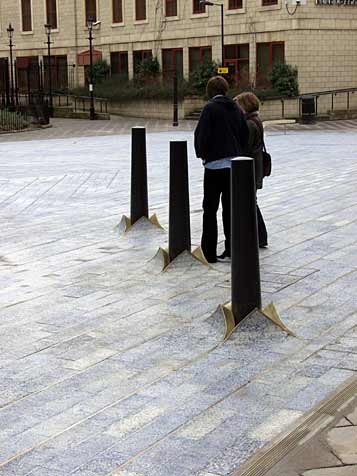
Time to simply gawp at some great spatial urban artistry methinks – in the form of street furniture by Thomas Heatherwick. ‘The Blue Carpet’ (article here) can be found in Newcastle, England:


Meanwhile Heatherwick’s been up to some other interesting stuff too:

- Rolling Bridge


Good bad urban design?

Today I’ve started wondering if there as any such thing as good bad urban design. Obviously not everywhere can be some sort of urban paradise of aesthetic beauty, physical functionality and social conviviality – does bad urban design play its part in making good urban design stand out, be appreciated more and have a more powerful positive impact by way of comparison as a result?

Further – it’s popped up here and there over the past week or so (in conversation will colleagues, general reading etc) that there is a need to cater for the fringes of society. If we make every street corner crisp and clean, where there are not dodgy shadowy areas, no homeless people or litter – are we in danger of not building up awareness of what is bad? The best way to explain this is the example of the over-protective parent that doesn’t expose their child to danger – as a result, the child might not develop properly from a lack of being exposed to both good and bad.

In the race to push for great urban design – are we forgetting that there might well be a place for badly designed spaces?… and that just like well design spaces – if they are accompanied by the right social message they could be places of positive impact?
I’m starting to really engage with the idea that the success of urban environments beyond the basics of ‘practical’ and ‘safe’ urban design may well be much more to do with issues of society and perception than bricks and mortar…

I’m off to read this now: ‘What are we scared of? The value of risk in designing public space’... and keep this quote from Jane Jacobs in mind:

‘Architecture and urban design may not determine human behaviour, but bad design can numb the human spirit’

(Jane Jacobs quoted by David Lammy, ‘The cost of bad design’)

___________________________

After-thought:
Good Urban Design = Good Space + Potential for Good Place.
Bad Urban Design = Bad Space + Potential for Good Place.

Space being that which is physically tangible about a defined location.
Place being that which is socially ethereal about a defined location.

30.10.08

Is this your airport or mine?


Another 'lunch ‘n‘ learn' today at CABE and this time Maurits Schaafsma was talking about the spatio-economic vision for the Schiphol region of Holland… Maurits is a Strategic Urban Planner at Schiphol Group, responsible for spatial planning, urban design, architecture and concept development… so not so surprisingly his talk was mainly based around the growth of Schipol airport from its birth just before the 1920’s to the present day.

Truth be known the presentation itself was a little ‘flat'… and having eaten a number of sandwiches the post-lunch slump started to kick in. I was hoping for some insights into cutting edge airport urban design and management – and whilst I got wind of ‘tangential runway systems’ and the spatial aspects of an ‘airport city’ it was the Q&A afterwards that proved to be most thoughtful.

Someone raised the matter of the neutral images of airports… how essentially each one looks like any other no-matter where in the world you are… and that perhaps there is a way to move forward in the development of these very busy public spaces in reflecting the locality or nationality of where they are. Which is a good point.

So there I was thinking: ‘what does make a good airport’? Well essentially, if a BBC article on Heathrow Terminal 5 is any guide, there are 5 key things:

- design
- signage
- retail
- transport
- no queues

Ok, it was quite a crude article but some starting points none-the-less. Conversely a blogger of sorts also on the BBC posted a rather funny guide to what doesn’t make for good airports. Obviously a grumpy traveller.

A little more googling and it turns out there is some impressive and exciting stuff on the horizon… in particular designboom.com offer these fine examples:


Incheon international airport, transportation centre, South Korea:


Carrasco international airport expansion, Uruguay:


Bangkok international airport, Thailand


Beijing international airport, China


Impressive and iconic stuff (interesting that 3 of them are in the far-east) - but I wonder how effective they will be in promoting a sense of 'national identity' in welcoming visitors... and how they will work as successful international transport hubs... time will tell...

At least they certainly beat more ‘quaint’ examples:

28.10.08

This Is Not A Gateway


This weekend just gone saw east London host the ‘This Is Not A Gateway’ festival. I’m going to put it in their own words:

This Is Not A Gateway {TINAG} is a voluntary organisation that creates arenas/platforms for those whose point of reference is the city. Working across disciplines, TINAG encourages inter-cultural dialogue and rigorous production…’ – so there we go.

The festival was made up of a mix of exhibitions, films, workshops, discussions groups and seemed very interesting – but unfortunately I wasn’t able to attend… however if I could have I would have personally been really interested in the following:

Exhibitions:
4 in particular, all at café Otto in Dalston… one was a series of drawings exploring the ‘strangeness of people living in cities’ by Karolin Schnoor... the others showed various photographic work from Laura Braun (Dalston Postcards), David San Millian Del Rio (Passerby) and Gesche Wuerfel, Tristan Fennel and David Kendall (A Line Is There To Be Broken) – which was a collection of ‘photographs that scrutinise struggles between transformations of ‘place and ‘space’... studies of disruptions in ‘everyday life’ and the landscape’.

Film:
A selection of screenings called ‘Ways of Living: A film screening in epic chapters’ which was related to travel, migration, tourism, location and the wider concept of the journey. I really have a habit for enjoying, appreciating and wanting to pull apart depictions of travel in film – how it’s presented, what it comes to symbolise… the nature of changing ‘places’ on screen… and also, conversely, the way in which locations and travel impact upon the production and dissemination of film. So this would have been a treat.

Discussion:
Specifically ‘Writing the City: Regeneration and Literature’ which had the aim of considering ‘how might literature and community arts intersect with architecture urban design, planning and development’… which was chaired by Sarah Butler of Urban Words.

Workshop:
‘Influencing the City: The art of making space’ which saw ‘young urbanists present their different experiences and new models for creating and running independent urban cultural [workspaces]’. Essentially it seems this was mainly about considering how creative ‘hubs’ all over Europe have appeared in urban areas and were initially provided by governments or authoritative bodies but are now appearing through different frameworks. Quite interesting in considering the likes of official exhibitions spaces such as galleries and bars in areas of London like Shoreditch that also inter-mix with unofficial exhibition spaces like walls/alleys/coves – mainly out on the street.

Thanks to the inter-web I can take a look at some of the stuff online but obviously it’s not as good as if I had been able to go! Still… names to remember for the future and some food for thought from just hearing about what some of the festival was about… Also, there are plans to publish a Festival Anthology – so hopefully there’ll be some interesting bits in there when it comes along!

23.10.08

Convivial Urban Spaces...

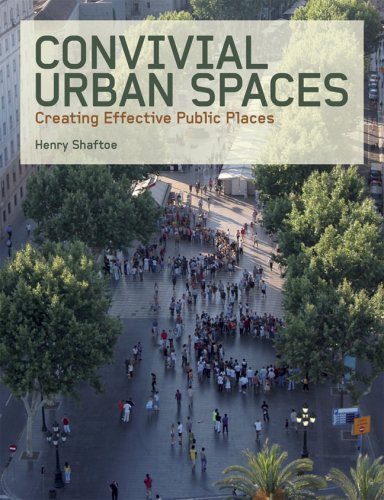
Henry Shaftoe from the University of West England gave a presentation at CABE on Tuesday... mainly focusing on his new book the theme was, you've guessed it, convivial urban spaces. For the more experienced 'urbanists' present he didn't seem to offer anything particularly new - but for myself it was nice to get a break-down of what research had shown made for sociable, lively and pleasant places... namely spaces that:
  • are inclusive & democratic
  • contain sitting places (!)
  • are well maintained and clean
  • feel safe and nonthreatening
  • have a distinctive character and identity
  • incorporate natural features
  • contains comfortable micro-climates
  • ban or tightly control vehicular circulation

Henry went on to break these down into 4 key elements 'urbanists' should consider when developing urban spaces:

  1. It's physical design
  2. The geographical location
  3. Management (including fixed and temporal animation of space)
  4. The Psychology of a space

The mention of the animation of public space got me down a path of thought that had me doodling away on my note-pad... particularly in thinking about temporal art. It's something I've been pondering for a while - but it was nice to have it 'boxed' as an aspect of public space that interests me and that has interconnections with notions of place as a whole.

Henry also went on to talk briefly about the idea of 'provisional spaces'... which wasn't something I'd thought about before - but the idea struck me. He was thinking about a method for creating places that was based upon developing an initial spatial plan, implementing it, testing it, evaluating feedback on how it does/doesn't work, amending it... and then eventually finishing with a final version of the space...


20.10.08

Rome wasn't built in a day...

Well, there's no time like the present!

Welcome to my blog! This is my first post, and the first thing I would like to do is apologise for any spelling and/or grammatical errors that are certain to appear at some point or another!

This is my blog... and I'm not quite sure what I want to do with it yet, other than use it to write about all the random things I come across that interest me in terms of the urban world...

I suppose I'm really interested in anything that makes up the 'urban composition'... thus the title of this blog...: the urban composition.

For me, I can break down what I really want to blog about into 4 categories... my 4 main urban interests:

1. geographically-spatial stuff
so mainly anything to do with architecture, planning, urban design etc...

2. iconographically-visual stuff
here I'm thinking about the urban world on screen, in films, in photos as well as urban iconography... signs, posters and things like that...

3. dramatically-kinetic stuff
this is mainly all about performance art - especially site specific theatre... but also the urban world in written literature and song...

and

4. artistically-tangible stuff
which is the sort of art that involves sculpture, light and texture... to a degree urban sound-scapes and slightly more 'off-beat' stuff like that...

So... there we go! I've (sort-of) set my agenda... I'll be testing out the blog over the next few months and working out how best to use it as an opportunity to leak my thoughts into the world and communicate ideas with others... this is a subjective blog, but it's not personal... my aim is to jot down my ideas and reflect my journey of discovering and thinking about the urban world... as well as a focus on stuff that might provoke the curiosity of other 'urbanists', urban designers, planners, architects, artists, performers, writers, designers... even policy makers and the like!

I expect I'll write quite ad-hoc... whilst I test the blog out - anything from several times a day to once or twice a month... and if anything catches your eye... feel free to contact me...

:-)